Showing posts with label dominicana. Show all posts

Sunday, July 14, 2013

Facts about dominicans in USA..


Dominicans were part of one of the largest migratory booms of the late 20th century. This migratory boom is made evident not just by the presence of Dominicans as an ethnic group, but from the Hispanic/Latino community in general.

An estimated 1.5 million Hispanics of Dominican origin resided in the United States in 2010, according to the Census Bureau’s American Community Survey. Dominicans in this statistical profile are people who self-identified as Hispanics of Dominican origin; this means either they themselves are Dominican immigrants or they trace their family ancestry to the Dominican Republic.

Let me tell you some facts:

  •  Immigration status. Nearly six-in-ten Dominicans (57%) in the United States are foreign born compared with 37% of Hispanics and 13% of the U.S. population overall. Most immigrants from the Dominican Republic (63%) arrived in the U.S. in 1990 or later.
  •  
  •  Educational attainment. Dominicans have higher levels of education than the Hispanic population overall. Some 15% of Dominicans ages 25 and older—compared with 13% of all U.S. Hispanics—have obtained at least a bachelor’s degree.

  •  Language. A majority (55%) of Dominicans speak English proficiently.3 The other 45% of Dominicans ages 5 and older report speaking English less than very well, compared with 35% of all Hispanics.

  •  Regional dispersion. Eight-in-ten Dominicans (79%) live in the Northeast, and nearly half (48%) live in New York.


 In considering those who are of Dominican ancestry this figure would almost certainly be much higher. And of all registered ethnic groups from Latin America, Dominicans make up the third largest group, after Mexicans and Cubans.


What characterizes Dominicans as an ethnic group in the United States is that they, unlike other groups that have come to the US, haven’t assimilated in the same way. Remittances from Dominicans in the US amount to an estimated 2 billion dollars a year, second only to Salvadoran remittances, which indicates a strong connection to the land of origin. Dominicans in the US also carve out particular enclaves within American cities, and tend to segregate themselves from other Hispanic and non-Hispanic groups. This is made evident by communities such as New York’s Washington Heights, which has the largest per capita concentration of Dominicans in the US

Spanish is the language of choice for most Dominicans, and another aspect that is characteristic of Dominicans is that they, unlike many other ethnic groups, refer to themselves as Dominicans, and not Dominican-Americans. Cubans, whether born in the US or not, call themselves Cuban-Americans, Puerto Ricans are referred to as Puerto Rican-Americans (or Nuyoricans in some cases), and Mexicans born in the United States are referred to as Chican@, all reflecting a joint level of pride for both heritages, but Dominicans have yet to embrace this as part of their identity.

They are ultimately very nationalistic, and the resounding idea among many Dominicans is that they are only in the US for limited periods of time in order to make money. Dominicans are inherently tied to their roots, and hold an overwhelming level of pride towards their culture and customs, which they aren’t willing to give up easily.
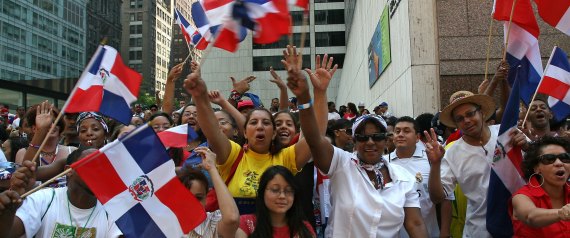


The situation for Dominicans in the United States is changing. With the growth of a more educated and skilled second generation, and an emphasis from within the Dominican community to integrate, it is only a matter of time before Dominicans become a more prominent part of American society, leaving behind the tainted image they have; though this won’t be easy. In the process, the Dominican community must come to terms with the creation of a bi-cultural generation of youth that is unable to find its own voice, while at the same time providing disenfranchised young people with the assurance that they are accepted members of both the Dominican and American communities.

Alongside the cultural struggles that face the future progress of the Dominican community is the advancement towards economic prosperity that can only further consolidate stability for this ethnic group

Tuesday, July 2, 2013

The agro industrial production in Dominican republic


We were reading about the expansion of Dominican Republic agro products exportations.we believe that for storage and distribution the dominicans can achieve better results using agro industrial products.

Agriculture in the Dominican Republic has changed dramatically during the later part of the last century. Agriculture employed some 60% of the population in 1960 and was reduced to 18% in the year 2000 (Banco Central, 2000).

The question that must be asked, is agricultural development a viable conservation and development strategy for rural communities in the Dominican Republic?

The Center for Planning and Ecumenical Action (CEPAE) founded on October 27, 1970 in the Dominican Republic believes that many development projects fail because they perceive agriculture as a technical activity.

Agro industrial would solve the storage and maintenance issues that can show up with our warm weather and timing issues.

Somehow these obstacle came to my mind:

  • An inconsistent and insufficient supply of raw material for no seasonal crops

  • Poor quality of raw material supply and high losses during transport from farm to factory

  • Poor and inconsistent quality of processed products ( the norm in dominican agriculture)

  • Sub-optimal use of processing facilities and equipment

  • Poorly trained personnel and a lack of qualified food technologists

  • A lack of proper sanitation practices of dominican and haitian workers ( we need to be realistic)

  • Inappropriate packaging materials and high packaging cost

  • Weak or non-existent market development and proper experience in DR

  • A lack of technical support for the agro-industrial sector in DR

  • Absence of good management of the processing facility once commercialized


  • Other issuers to consider include: Electricity and refrigeration issues, storage issues, road infrastructure issues, transportation of agro products in DR,proper logistic, Dominican burocracy,security, etc,etc


The question is what does it take as Dominicans to achieve those proper exporting goals?
I have to agree with Atabey that the future looks wider with Russian and Brazilian opportunities and new road infrastructure , but it takes the initiative of the private sector , not the government to do that.

The question is : Can we really do it?


For many years people have seen the agro industrial sector in a despective way.Instead , the importation of different issues in DR is the common thread.For example , you could see a lot of business importing oil and tires one by the side of the other but not a big complex in charge of exportation of agro industrial items..

First of all we need to identify the areas in DR for proper agriculture:

Map of the Agricultural Regions of Dominican Republic


This map shows the top food and other agricultural commodities produced in the Dominican Republic in 2008.
From the tonnage standpoint, sugarcane is, by far, the main agricultural product, with 4.8 million metric tons per year. From the value stand point, chicken, beef, and cow’s milk rank first, second, and third respectively

We need to check some of our main agro produce as well, for example:


But we haven't consider a lot of our produce to be exported to exotic destinations as well:sugar, distilleries produces, cassava ,swine packed produces, the  eggs and poultry produces,vegetable oil ,etc, etc..

People don't realize how lucky were are to have in front of us USA the biggest consumer in the world..And we barely see Dominican agro industrial produce in the market.

Another issue into consideration are the proper institutions that can support some of that exportation and productions and can give the proper orientations as well.I will name a few:

Asociación de Porcicultores del Cibao ,Consejo Estatal del Azucar, Centro de Desarrollo Agropecuario y Forestal ,Centro de Orientación, Apoyo yPromoción a la Inversión ,Instituto Interamericano de Cooperación para la Agricultura ,Instituto de Estabilización de Precios ,Junta
Agroempresarial Dominicana ,Secretaría de Estado deAgricultura ,Centro de Orientación, Apoyo y Promoción a la Inversión , etc, etc..

National exports, not including free zones, jumped 44% between January and February compared with the same period in 2012, Dominican Republic Export and Investment Center (CEI-RD) director Jean Alain Rodriguez affirmed
He said exports in the first two months in 2012 were US$390 million, climbing to US$560 million this year, or US$170 million more.

“Dominican exports continue to grow thanks to the different mechanisms implemented by president Danilo Medina, in support of small and medium enterprises, which have boosted this sector,” the official said, and announced the Dominican Agribusiness Board’s (JAD)

 The number of countries to which organic produce is exported has been increasing steadily. During the year 2000, products were exported to at least 21 countries in the Caribbean, North America, Europe and Asia. Over 80 percent of the produce was exported to Europe. The main markets by volume were the United Kingdom and Belgium followed by the United States, Germany, the Netherlands and Italy in decreasing order

 The potential for increased production of all crops and diversification is enormous. Indeed, there is already a trend to increase the product range. The growing domestic market as well as regional markets provide some potential particularly for vegetables. Indeed, it is envisaged that in the short term, expansion of organic production will track global trends in demand. Thus 5-10 percent growth is projected annually. Some of the major challenges concern production. These include production of sufficient product of high quality to satisfy demand, technical support for farmers, provision of affordable credit, suitable shipping schedules and growing competition

Toward the middle of this decade DR we will see an increase of the export for several reasons: acceleration in the pace of globalization and trade liberation and new market access, but that will require more domestic support commitment by Danilo's government as well.

Our expectations are high.The opportunities are endless..When there is a will, there is a way..


Monday, June 24, 2013

Dominican Republic: Latin American tourism champion


MIAMI.- (Latinvex).- The Dominican Republic continues to be a Latin American champion in receipts as a percent of its GDP, according to a to a Latinvex analysis data from the World Tourism Organization and the International Monetary Fund.

Dominican tourism receipts last year reached US$4.5 billion. That was 7.7 percent of the country's US$59 billion economy. No other country in Latin America as a high a ratio between receipts and GDP.
Meanwhile, international arrivals grew by 5.9 percent to 4.6 million. When compared to its population, the arrival ratio is 40.3 percent, the third-highest in Latin America.

On average each visitor spent US$996.9, considerably higher than the Latin American average of US$860, according to Latinvex.
 
The Dominican Republic ranks fourth in Latin America in terms of both number of tourists and receipts from tourists. Mexico leads, followed by Brazil and Argentina.
Overall, Latin America received a total of 80.2 million international arrivals last year, an increase of 3.1 percent from 2011. Total receipts reached US$68.9 billion, a 5.3 percent increase.

Thursday, June 13, 2013

Where are you from? From the Island of la Hispaniola , la isla de Santo Domingo o Saint-Domingue?

Where are you from? Quisqueya, Santo Domingo, Haiti, La Espanola o la Hispaniola?


I was having an argument in South Florida.An old friend of mine was arguing that he was from la Hispaniola, I told him I am from the Island of Santo Domingo, so probably we are from different countries.

Sometimes when people ask me where i am from, saying i am Dominican, I have to clarify that i am dominican from Dominican republic, not from the island of Dominica, so it get more confusing..

To clarify this I have to go back to my own people history...


La Española es una isla situada en el archipiélago de las Antillas Mayores en el Caribe, la cual contiene a los estados soberanos República Dominicana y Haití.

La Española es conocida por ser el lugar del primer asentamiento europeo en el Nuevo Mundo, descubierta por Cristóbal Colón en su primer viaje en 1492.
Es la décima isla más poblada del mundo, y la más poblada de América.
Es la isla número 22 en tamaño en el mundo.

The island bears various names originated by its native people, the Taíno Amerindians. When Columbus took possession of the island in 1492 he named it Hispana in Latin and La Isla Española, meaning "The Spanish Island", in Spanish. Bartolomé de las Casas shortened the name to "Española", and when Pietro Martyr d‘Anghiera detailed his account of the island in Latin, he translated the name as Hispaniola, Because Anghiera’s literary work was translated into English and French in a short period of time, the name "Hispaniola" became the most frequently used term in English-speaking countries for the island in scientific and cartographic works.


Gonzalo Fernández de Oviedo and de las Casas documented that the island was called Haití ("Mountainous Land" by the Taíno. D‘Anghiera added another name, Quizqueia (supposedly "Mother of all Lands", but later research shows that the word does not seem to derive from the original Arawak Taíno language.] Although the Taínos use of Haití is verified and the name was used by all three historians, evidence suggests that it probably was not the Taíno name of the whole island. Haití was the Taíno name of a region (now known as Los Haitises) in the northeastern section of the present-day Dominican Republic. In the oldest documented map of the island, created by Andrés de Morales, that region is named Montes de Haití ("Haiti Mountains".
Las Casas apparently named the whole island Haití on the basis of that particular region;] d‘Anghiera said that the name of one part was given to the whole island

The colonial terms Saint-Domingue and Santo Domingo are sometimes still applied to the whole island, although these names refer, respectively, to the colonies that became Haiti and the Dominican Republic.

The name] Haïti was adopted by Haitian revolutionary Jean-Jacques Dessalines as the official name of independent Saint-Domingue, as a tribute to the Amerindian predecessors. Quisqueya (disambiguation needed] (from Quizqueia) is used to refer to the Dominican Republic.

So, after this small research, I am confused how to answer the question of "where are you from?"


So ,after all this information, in the future..If somebody ask you..where are you from..What will you answer and why?
Edited on 6/12/2013 2:24 PM by ohhhvictor.

Tuesday, June 4, 2013

The first immigrant in NY was dominican !

Juan Rodriguez , first foreigner ( and dominican! ) in NYC, 1613


At the renaming of Broadway into Juan Rodriguez Way. The first nyc immigrant from 1625 who was a black, free dominican man.


About three miles of northern Manhattan today honor a man who, until recently, was unknown to most of the people who live there.

Juan Rodriguez Way will be the name of Broadway from 159th to 218th Streets, after an early settler from Santo Domingo who reportedly arrived in New York in 1613. Rodriguez is believed to be the city’s first Dominican immigrant, as well as its first free black settler, its first Latino and its first non-Native American merchant.

“It completely re-conceptualizes the Dominican presence in NYC,” said Led Black, a local Dominican-American writer and editor of the Uptown Collective. “I think many Dominicans feel that even though we have been a part of this city for quite some time now, we have been left out of the city’s narrative and that is starting to change finally.”

Though many uptown residents are now learning about Rodriguez through efforts by the CUNY Dominican Studies Institute, which uncovered his story, Rodriguez’s existence had been completely unknown by the uptown community, with its high Dominican population.

Anthony Stevens, an assistant director at the Dominican Studies Institute, worked to unravel Rodriguez’s history and pushed for the Broadway co-naming. From what Stevens and other researchers have gathered so far, Rodriguez appears to have landed somewhere in the Hudson Bay area while on board a Dutch expedition ship.

“He’s sort of the first immigrant,” Stevens said. “Not just the first settler, because he came from afar — another culture, another place.”

Black noted the renewed sense of pride Rodriguez’ history offered Dominicans.

“People are generally happy to find out our history predates the last 50 years,” he said. “Most had no idea but once they knew, they were pretty proud of it.”

Many locals, though unfamiliar with Rodriguez, found the history interesting. Mary Kate Burke, a teacher born and raised in Inwood, was fascinated by the news.

“That is really amazing,” she said. “The thing about this area is, you always associate Dominican culture with the influx of immigrants in the ‘60s or ‘70s, not the 1600s.”

Emmanuel Abreu, lifetime local of Washington Heights, was one community member familiar with Juan Rodriguez and the upcoming street co-naming.

“I think it’s important to everyone, especially Dominicans in Washington Heights,” Abreu said. “Or at least it should be.”


An archival document about Juan Rodriguez from the Archives of the City of Amsterdam. (Reproduction by the CUNY Dominican Studies Institute)

El primero de nosotros en estas tierras! Seguimos sigiendole sus pasos!
Arriba esas banderas!

Sunday, May 26, 2013

You know you are dominican if

For 50 things…
YOU KNOW YOU’RE DOMINICAN IF . . .


If Some of your favorite expressions consist of:
“coño”
“Anda la mierda”
“Anda el diablo”
“El diache”
“Que Vaina”
“Dimelo”
“Ta’ To”
“Y Es Facil”
“Que lo Que?”
“A Po Ta Bien”
“Que Tripeo”
“Tu si Jode”
“Ta Cool”
“Ta Jevi”
“La creta”
“Tu ta pasa”
“Cojelo suave”
“Que Bufeo”
“Degrasia”
“Mariconaso”
“Malba”
“Barbarasa”
“Pariguayo”


If you live, or got family livin in Washington Heights (better said Guaachinton Heights) . . . Or NY in general, this also includes Florida…
If people tell you to stop screaming when you’re really talking
If you grew up afraid of something called “El Cuco”
If you clap your hands while laughing
If you have more Primos and Primas, and you talk about at least one that is famous or rich (lots of cousins).
If your able to dance without any music
If you learned how to dance merengue and bachata before you could walk
If you point things out with your nose and mouth
If you’ve ever gotten beat with any of the following:
rubber slippers, extension cord, hanger (plastic or metal), big rice spoon
If you waste ALL your money in the summer time buying “frio-frio” RED FLAVOR
If you’ve ever gone outside in rolos and chancletas
If you consider a siesta a sacret tradition for the family. Specially between noon and 2pm where the family gets together and eats, more platanos, rice & beans of course…

If your parents go to a little room in the back of your local bodega “pa juga lo numero” of DR
If you consider platanos one of the major food groups
If you can smell chuletas cookin in your house from down the block
If while in your country, you hear people on the block yellin “se fue la luz!”; Them you also hear “Llego La Luz”

If your house in DR has an oil lamp in every room
If you told scary stories and funny jokes while there was no electricity
If you grew up listening to Fernandito Villalona, Sergio Vargas, and Los Hermanos Rosario
If your dad or uncle claim to be dead broke, yet rock a cell phone and is laced wit mad gold around his neck and wrists
If you Drop Liquor on the floor and say “eso e pa lo muerto!”
If you like El Concon (which is the hard part of the rice) and Habichuelas con dulce.
If you’ve ever gotten whipped by a diablo cojuelo or lechon
 
If your grandma has a saint picture in her living room
If your sofas are covered in plastic
If you all the juices you have in your house are the type that come in powder, and you just mix with water, like Tang
If you eat Mangu on a daily basis

If you ate rice, beans and some type of meat for dinner yesterday, today and probably will tomorrow. Also for breakfast, lunch and dinner…
If you say words like . . . . . . . . Razor is GILE . . . . . . . . Nailpolish is CUTé . . . . . . . Feminine Pads are KOTE . . . . . . . . Vicks Vapo Rub is Vivaporu . . . . . . . . T-Shirts are POLOCHE . . . . . . . . Watchman is GUACHIMAN . . . . . . . . .Garbage is EL Gabish . . . . . . . .Cereal is CONFLE
(Yea you all know you do it!)
If you believe Vivaporu is the cure for EVERYTHING
If you in a 4-passenger car, u got 7 people in it, and someone yellin “caben ma”
If you’ve ever been in a carro publico ;)
 
If you use an old t-shirt, towel, or anything as a mop, and use your feet to mop
If you’ve ever let some one throw AGUA FLORIDA on you for good luck
If your house on the island has broken pieces of glass to keep away robbers
If you refer to every cat as MISHU
If your childhood games were called: EL ESCONDIDO, POLLITO PLEIBI, APARA Y BATEA, EL GALLO, or that game with a stick and a wheel
IF your parents dressed you up for Halloween as a VAQUERO, CAMPESINA, GITANA, OR HAWALLANA
If your refridgerator has about 85 magnets on it
If all your pots and pans are inside the oven
If your local bodega does lay-a-away/credit plans (fiao)
If you think Bananas or Platanos are a source of Power and call it “Banana Power”.


If you are proud of your roots, and everywhere you go you take DR with you..Because DR will never leave you..